Tuesday, August 25, 2009

Senses working overtime


"Doctor, my 3 year old totally has ADHD. He cannot sit still. He has a hard time concentrating and staying on task. Can I get something to help with him? Please FIX HIM!"

Diagnosis: normal 3 year old.

ADD/ADHD (I'll just refer to it as ADHD from here on out because I'm lazy) seemed to be all the rage in the 90's. Seems to now to have taken a back seat to 'Autistic Spectrum Disorders'. It is still relevant, and while it doesn't get the press/publicity of autism, it is definitely more common.


First question: Does it really exist, or is it just a reflection of a generation of bad parents?
First answer: Yes, it does exist.

There are many kids that seem to very obviously have this diagnosis. The medication to treat is consists of a group of stimulants. If you give someone a stimulant and it CALMS THEM DOWN, I'd say that's pretty good evidence that they have some 'crossed wires' so to speak. It is a highly genetic situation, so kids with it are likely to have parents that suffered similarly as a child (and some continue to as adults).


Second question: Does my child with ADHD need medication?
Second answer: Maybe.


Parenting plays a large roll in ADHD. No, a bad parent cannot make a child get ADHD. There is something that genetically predisposes these children to behave they way they do, but poor parenting can really bring it out. Parent training has found to be so beneficial that many kids not longer need medication after their parents learn the right way to 'parent' them. Most of this training focuses on teaching the child organizational skills including making daily schedules/routines, simple and CONSISTENT house rules, close supervision, and a reward system that focuses on effort, not necessarily results. Sleep schedule is extremely important, as lack of sleep really exacerbates the symptoms. In fact, sometimes obstructive sleep apnea is misdiagnosed as ADHD. So if you have a hyper child that snores, get that checked out. After all that, though, there will still be a quite a few children that will need medication to function well.

Third question: Isn't it just easier to give them a pill to pop than to learn how to be a better parent?
Third answer: Yes.

Studies clearly show that even with medication, proper parenting techniques are invaluable. Do your kid a favor and get the training you need in order to give them the best chance to succeed. I will admit, though, I have had some parents that are so disorganized and ADHD themselves (its genetic, remember) that I don't even bring up parent training, because I don't believe in exercises in futility.

Fourth question: If I eliminate sugar from his diet, will he be normal?
Fourth answer: Probably not.

There are may people out there trying to sell their diet plans to help with ADHD. There is very little scientific basis for this. Most of the time, it is the case of a person who wants to prey upon someone else who is desperate for help (which describes pretty much any parent of an ADHD child). That doesn't mean they don't help at all. There may be a diet component, but I think these dietary needs can vary wildly between children. I don't see any problem trying different diet routines, as long as it doesn't but an undue financial (or other) stress upon your family. NONE of the diets work for every child. The parenting techniques described above help to some extent for EVERY child. Start with those, then consider diet therapy, but keep your expectations low and your wallet tightly closed.


Monday, July 27, 2009

Brain of J.

Ok, folks, I've officially emptied my brain of the original pediatric ideas I had for my initial blog postings (don't worry, more diet reviews to come). So I'd like to open it up for questions... Any recommendations for other subjects? What have you always wanted to ask your pediatrician but where afraid to ask?

There is an old adage, "There are no dumb questions." I'll be honest and say I don't believe in it. There are plenty of dumb questions, but don't worry, I won't tell you if your question is dumb. Plus the dumb ones may be the same things that everyone is wondering about, but doctors don't bring it up, becuase they think everyone knows it...

Friday, July 24, 2009

Jenny (867-5309)

I thought I'd start a series of diet reviews to evaluate the pluses and minuses of each of the popular diets available.... I'll rate each on ease of following, medical safety, and chance of keeping the weight off.

The first 'diet' I'll start with are the prepared food plans (like Jenny Craig, Nutrisystem, Weight Watchers, etc).


***the funny thing about this ad, is it says 'results not typical'. I've seen that disclaimer on the 150 pound losers, but 30 lbs? It's not typical to lose 30 lbs?


The basic plan is to eat the food they have prepared for you, and if you only eat a certain amount of it, you will lose weight. Honestly, I'm sure it's clear that this is just a low calorie diet (as I have said previously is the best) where they count the calories for you. Most of these diet plans are based on an 1800 calorie a day intake. If you learned to count calories yourself and kept to 1800 calories a day, you would lose weight for free. But, yes, that does take a lot of work at first, and these companies eliminate that work for you.

Ease of following: Pretty easy, as long as you have to money to pay for it. You do have to buy food to eat anyway, so its probably not exorbitantly more expensive than regular food. In fact, if you eat a Claim Jumper for every meal, I'm sure it is cheaper. The big problem with its 'ease' is it is a little restrictive; ie, if you wanted to Taco Bell for lunch, you can't. And if you like fresh food from your garden, that's not part of the plan either. Its mostly frozen food from the microwave.


***mmm looks delicious


Medical safety: Very safe.

Chance of keeping the weight off: Good until the money runs out, or you get bored of their food. Actually, 80% of Jenny Craig's business is repeat. In fact, if she got everyone to lose weight and keep it off, she would go out of business. She wants you to depend on her. (I shouldn't be too hard on Jenny Craig keeping people fat, so she can have business, as my grandmother thinks doctors keep people sick, so they will have business!)

Conclusion: Learn about what you are putting in your mouth! Learn how to count calories yourself and plan your own meals with your own food (and even Taco Bell's food, if you'd like). Plus you develop a life long skill and habit (if you get really good at it) that will help you be healthy FOREVER (well at least until you die).

Monday, July 6, 2009

Blister in the Sun


Alright, its summertime, and time to worship the sun god.
A very popular question we hear in the clinic is, "How much SPF do I need?" There's nothing America likes more than hysteria and overdoing it... Let me give you some data to chew on... the SPF of a 100% cotton shirt has been sited to have an SPF of somewhere in the range of 4-15. (Yes, don't you love the exact answers science likes to give us.) So if I'm being really honest with you, if you don't get a sunburn with a t-shirt on, you probably don't need anything more than SPF 15. But, doctor's aren't above the hysteria apparently, because I still recommend about SPF 30 for most kids. Anything over that really is overkill, so don't waste your money. Of course if the SPF 100 is on sale and cheaper, feel free, but I haven't heard of any real added benefit over SPF 30.
.
The next question of course is: Can I put sunscreen on my infant less than 12 months of age?
My answer to this question is avoidant and simple: The best sunscreen for a baby is SHADE. Please, people, does your baby really need to lay out in the sun? If your family is enjoying a day out in the sun keep your baby covered! Especially if they are less than 6 months. A sunburn can be very severe in this age group, so don't mess around. Plus, they'll probably end up sucking the sunscreen off of their hands anyway, which are probably the most exposed part of the baby's body. Keep your kids in the shade until they are old enough to move around and play in the sun on their own, then hit them with the SPF 30. If you don't think you can keep your baby in the shade there are a million baby sunscreens you can try, and they are probably fine, but just be really safe and stick with the shade.

Thursday, May 28, 2009

Let's Go To Bed


Just a quick post on a subject that bothers me because the danger of its practice still doesn't get universal acceptance in the pediatric community: co-sleeping. This is probably because a major pediatric celebrity (Dr Sears) still hold fast to the notion that it is alright, even beneficial. I will have to beg to differ on this subject. I spent a month in autopsy while in medical school. We would get about a baby a week, and most of the ones I had seen were victims of cosleeping. All of them were at least victims of being put to sleep in an adult bed.
.
Just to be clear: co-sleeping is having your baby sleep in bed with you. Most other doctors (besides Dr Sears) believe that adult beds are death traps for babies with or without an adult in them. Even when Dr Sears went on Dr Phil, Dr Phil had to 'respectfully disagree' with him on the subject. And Dr Phil usually slurps his celebrity guests, so to make a stand, I was impressed. If you read Dr Sears website, he will make some convincing arguments and even state some evidence. But trust me, the evidence to avoid adult beds for babies far outweighs any studies he quotes.
.
Since I've been at my current job, I've gone to 3 'codes' in which a baby arrived dead to the ER. Also, all three of these were in adult beds, some with other sleepers.
.
Without the risk of death, I have to admit I have other concerns of the baby interfering with the parents' relationship. Sometimes bedtime is the only time parents get a chance to converse and touch base. Throw a baby in the middle, and you get no alone time for the two.
.
Bottom line for me: leave the baby in the crib.

Tuesday, April 28, 2009

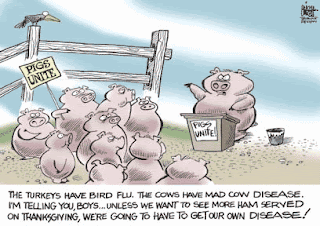
Who kissed the pig?


So everyone's all in a tizzy about this swine flu business. Instead of writing about it I found a good resource for information that is frequently updated put up by Kaiser here. It takes you directly to patient instructions, but if you want even more info, just click on the home tab when you are there.

** This should not be construed as a endorsement of Kaiser of my blog. In fact, any perceived connection between Kaiser and this blog is purely coincidental.

Here's my bottom line: Flu by whatever name is still the flu. You have a greater chance of winning the lottery than being killed by the flu no matter if it is swine, avian, regular flu. If you caught it, you would get a fever, cough, sore throat, etc for a few days, just like the regular flu. In fact you should probably be more worried about catching the regular old flu, there's been more of it here in America. I guess its just not as fun to get all stressed out by boring old regular flu...


911 is a joke

It's my favorite thing... I'm on call overnight at the hospital and my pleasant slumber is interrupted by the ugly sound of my pager. I call down to the ER. They want me to consult on a patient who has been having a problem for two weeks. For some reason at 3 o'clock this morning was the time they had just HAD ENOUGH. Instead of waiting until the clinic opened the next morning, they needed answers NOW! So since the ER provider isn't used to dealing with such issues (they are EMERGENCY doctors), they get a 4AM personal pediatrics consult from me. Sure quick answers are great, until the bill comes in the mail.

If you have kids, you've been there... Its the middle of the night and something's not quite right with your little one. Is it an emergency? Should you wait until the morning? How about a compromise and just go to urgent care? I know, you try to get an appointment for your doctor and they don't have any openings for WEEKS. You can't wait that long.


There is a fairly new buzzword in the medical community called 'access'. Which just basically asks if your patients have access to your care in a reasonable amount of time. Most pediatrics clinics, as a result have put a high priority on getting same-day access to your physician. So hopefully the days of waiting days and weeks to get in to your child's doctor are over. In the busy winter months you may have to wait a day or so, but most clinics that are up to speed should be able accomodate.

I'll be honest. Most ER's and Urgent Cares don't have a guy like me (a pediatric guru/pediatrician)available to them, and when it comes to non-emergent cases, provide very poor care. Sure you may get your answer more quickly, but its likely to be the wrong one and you are going to pay more in copays,etc for it. Don't get me wrong, there are some excellent clinicians that work some of these late night places, but you, as a patient, aren't going to have any idea (see my first post ever). And, the numbers of good docs to bad docs in many of these places is pathetically low. To their credit, they are usually good in emergent situation, which is what they are trained for.

So I thought I'd give you a list of symptoms/situations your child may have and a breakdown of the severity in case one of these sneaks up on you in the middle of the night (this list is not exhaustive, but I tried to think of the most common - it may be a big mistake on my part to try it - remember disclaimer to the right):

Call 911:
Stops breathing/turns blue and stays blue
Seizure that doesn't stop
Passed out and not waking up
Difficulty breathing after contact with something they are allergic to
Concern that your child may have swine flu - PLEASE NOTE ITALICS HERE

ER:
Fever and stiff neck/baby's fontanelle(soft spot) is bulging
Persistant difficulty breathing (with asthma or otherwise) - this can be breathing fast that doesn't slow down, persistant skin sucking around the ribs, and/or difficulty getting out a few words
New or first seizure that stops on its own
Not very responsive, difficulty waking up.
Fever >105 (I might lower this to 104 for older kids >7-8 year old range)
A baby less than one month old with any fever (>100.4)
Your child is not acting like themself after having vomiting/diarrhea and being unable to take fluids
Fever and refusal to walk/excessive bone/joint pain
Lip/facial swelling after contact with something they are allergic to
Pain that is so intense it cannot wait for an appointment (wherever it is located)

Urgent care or ER:
Suspect a broken bone or may need stitches (actually these locations are probably better than your general pediatrician with these issues)
Head injury with loss of consciousness, but doing okay now
Persistant asthma that has difficulty breathing that comes back less than 3-4 hours after albuterol treatment.

**general note: Urgent Care facilities are good for injury-type complaints, but will otherwise usually give poor medical care for kids

Wait until the next day and see your pediatrician:
Almost anything else that is abnormal, but your child is eating, breathing, and acting normally otherwise
High fever, unless it gets above 105 or there are other symptoms you are concerned about
Anything that has been going or for days and didn't get suddenly much worse
Swollen lymph nodes
Persistant asthma but able to breath comfortably for several hours after breathing treatments
Baby is fussy and won't stop fussing (unless they really seem to be in great distress)
Your child is still acting like themself, but has been unable to keep and fluids down for >24 hours due to vomiting
Runny nose, cough, etc.


***If you have any additions/suggestions/questions feel free to comment, and I will try to update the list.

I am a big fan of mother's/woman's intuition, so if you REALLY think something is emergently wrong take your child to the ER, even if they don't fit a category above.